Gravity measurements are a unique tool for imaging the subsurface, as they provide direct information on variations in the surrounding mass. They also play a vital role in establishing terrestrial spatial references. Gravimetry enables the mapping and monitoring of subsurface dynamics, and applications are numerous : geothermal energy, monitoring of climate change, groundwater levels and volcanoes, underground gas storage…
After decades of research, development and industrial transfer, quantum technologies have reached a sufficient level of maturity to enable the use of robust, field-ready quantum gravimeters, offering numerous advantages over the instruments used to date.
How does a quantum gravimeter work ?
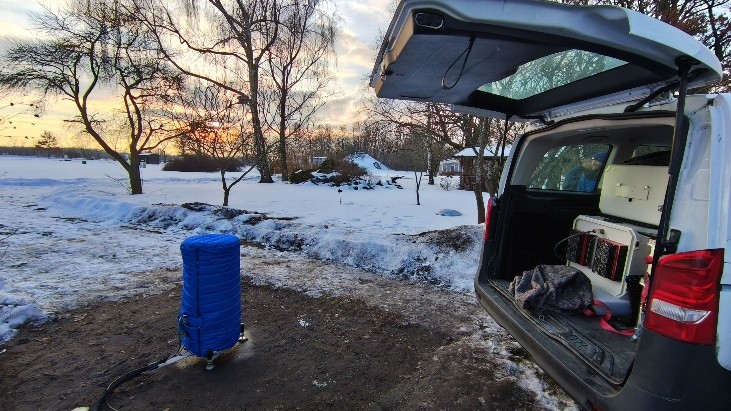
A quantum gravimeter is a sensor that replicates Newton’s apple experiment. Several times per second, atoms are trapped and cooled using a laser to form a sample of matter. This test mass is then released into free fall in a vacuum. The vertical acceleration, g, experienced by the atoms is measured using atomic interferometry. This technique enables high-precision measurements to be taken continuously, typically at a rate of 2 Hz, by causing waves of matter manipulated by laser pulses to interfere.
The LNE-OP at the LTE laboratory was one of the world’s pioneers in atomic interferometry from the early 2000s, and part of this research was successfully transferred to industry in the 2010s. Active research on the subject continues to be carried out.
Why apply ?
This call represents a unique opportunity :
- to gain access to state-of-the-art instruments without a significant financial outlay,
- to receive support and training from the consortium’s experts,
- to explore new applications within your field of research.
How to apply ?
Interested teams – including those with no prior experience in gravimetry – are invited to submit their applications by 31 July 2026 to the following address : ipe chez equip-g.eu
The application form is available on the EQUIP-G project website
About EQUIP-G
EQUIP-G works to establish a sustainable European research infrastructure that manages a shared fleet of quantum gravimeters, for the benefit of the European scientific community. At EQUIP-G, we acquire and validate quantum gravimeters. We deploy them in the field across Europe to meet a variety of needs, ranging from water resource management to geothermal energy monitoring. We ensure the wide dissemination of the data collected in accordance with FAIR principles. We train new operators and strengthen the European community of gravimetry users.
EQUIP-G brings together twenty European organisations across eleven European countries. In France, the consortium draws on the metrological expertise of the LNE and benefits from its gravimeter evaluation infrastructure to ensure the traceability of measurements and the monitoring of instruments.
In 2029, the EQUIP-G project is due to provide the European Commission with details and recommendations regarding a future fleet of shared instruments.