In November 2025, the European Space Agency’s Juice mission trained five of its scientific instruments on the interstellar comet 3I/ATLAS, shedding new light on this rare visitor from another star system.
Among them, the MAJIS (Moons And Jupiter Imaging Spectrometer) instrument identified infrared emissions of water vapor (H2O) and carbon dioxide (CO2), as well as light scattering by the coma in the visible/near-infrared spectrum, on November 2, 2025, four days after its perihelion passage on October 29, 2025. Other weaker emissions were also observed on November 12 and 19.
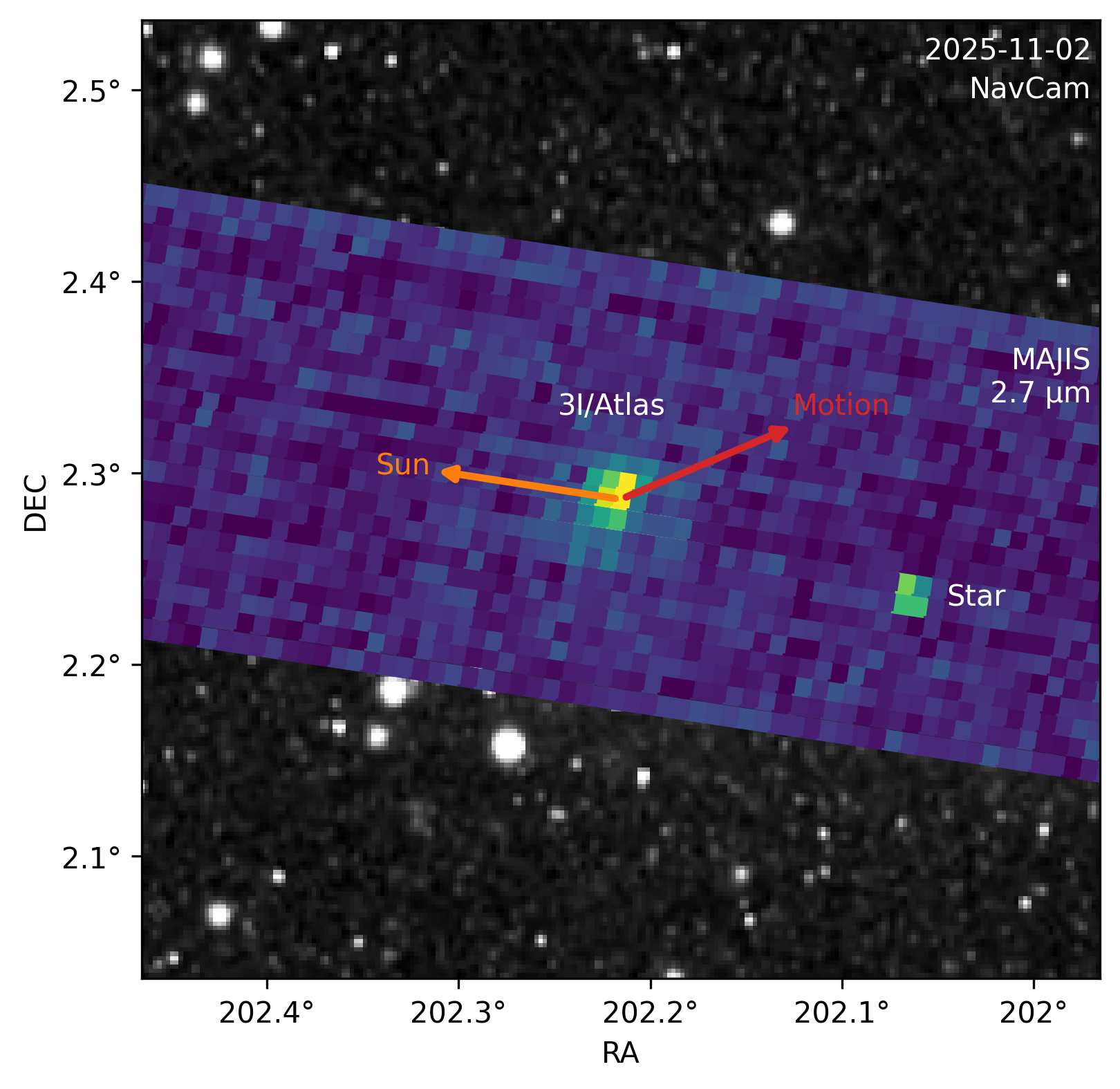
As with any comet approaching the Sun, the increase in solar flux causes the surface layers to gradually heat up, followed by the sublimation of ices as the heat penetrates deeper. This sublimation fuels the formation of a coma, a diffuse envelope composed of gas and dust surrounding the nucleus. Repeated detections of H2O and CO2 by MAJIS indicate that volatile ices buried beneath the surface were actively being released into space shortly after perihelion at a rate of 2 tons per second, which corresponds roughly to the equivalent of 70 Olympic-sized swimming pools of water vapor expelled into space every 24 hours.
The 3I/ATLAS observations by MAJIS presented an operational challenge due to the short observation periods, the weak signal, and thermal conditions that were not ideal for MAJIS, a cryogenic instrument. In the months following the campaign, Juice was on the opposite side of the Sun from Earth, so the MAJIS team had to wait until late February to receive and begin a thorough analysis of the data.
Comet 3I/ATLAS, discovered on July 1, 2025, by the ATLAS (Asteroid Terrestrial-impact Last Alert System) monitoring system in Chile and identified as interstellar due to its hyperbolic trajectory and high velocity, is only the third object of this type observed passing through our Solar System. The MAJIS data will provide a better understanding of its post-perihelion activity and the physicochemical properties of materials formed around another star billions of years ago.
These opportunistic observations demonstrate the mission’s versatility and MAJIS’s ability to contribute to the study of transient objects with weak signals. The detection of very faint cometary signals from 3I/ATLAS validates the capability of the specific acquisition mode used by MAJIS to reliably assess signal levels close to the noise floor. This demonstration proved decisive for future observations in the Jovian system, particularly for the study of the tenuous exospheres of the icy moons and Jupiter’s rings, for which sensitivity to low fluxes will be a central challenge.
The French instrument MAJIS is an infrared imaging spectrometer, whose primary mission is to characterize the surfaces of Jupiter’s moons. MAJIS was developed by a broad consortium of European scientists and engineers, with major contributions from France and Italy, thanks to the support of their respective space agencies, CNES and ASI (Agenzia Spaziale Italiana). The Institute of Space Astrophysics (IAS – France), a laboratory under the supervision of the CNRS and Paris-Saclay University, is the scientific and technical lead for the instrument, with the Istituto Nazionale di Astrofisica (INAF – Italy) serving as co-lead.
France is contributing to the mission through the participation of several French laboratories (C2N, IAS, IPAG, IPGP, IRAP, LAB, LATMOS, LIRA, LPC2E, LPG, LPP), which have worked on the development of the instruments carried aboard the probe. CNES supports the French laboratories involved in the development of JUICE’s scientific instruments. The French space agency is responsible for funding the industrial contracts for all French contributions, including MAJIS and the supplies from the other French laboratories contributing to the five other instruments, and also provides the expertise of its technical center on a wide range of topics (electromagnetic compatibility (EMC), component integration techniques, reliability, flight software, etc.).
Reference
On the same topic,
- the press release published on 2 april 2026 on the ESA website :
"Five things Juice has revealed about Comet 3I/ATLAS"
- the press release published on 3 april 2026 on the CNES website :
"Quand l’instrument MAJIS, à bord de la mission JUICE, croise la route du voyageur interstellaire 3I/ATLAS"