Celestial bodies between planets and stars
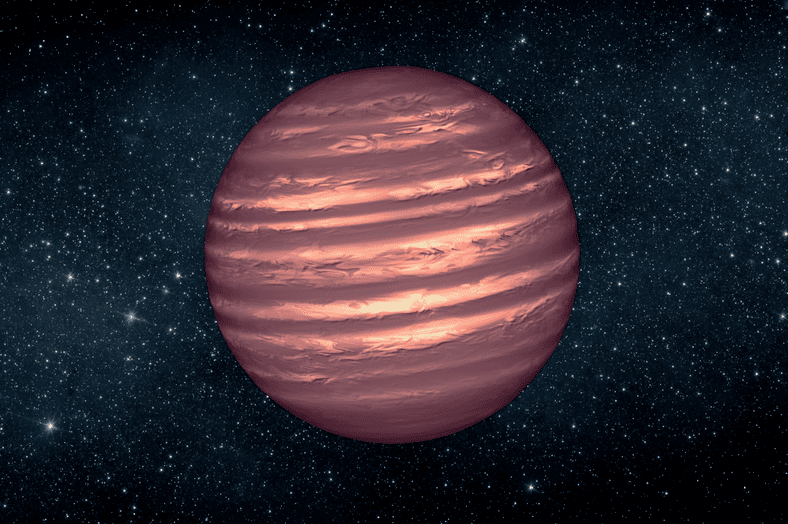
Brown dwarfs are objects with masses between 13 and 80 times that of Jupiter, capable of fusing deuterium but not hydrogen. They undergo continuous cooling, starting at temperatures above 2,000°C after their formation, until they reach temperatures between 100°C and 0°C for the oldest and least massive ones. Brown dwarfs serve as excellent analogues to exoplanets observed by direct imaging and in laboratories for studying atmospheres. Indeed, similar atmospheric processes are expected for both categories, while isolated brown dwarfs are much easier to observe than exoplanets due to the absence of a bright host star.
The L–T transition : a key stage in the cooling of brown dwarfs
Observations of brown dwarfs have revealed a significant change in their spectra and photometry during their cooling when they reach approximately 1,000°C. This transition, known as the L-T transition, is explained by the effect of clouds of iron and rock (silicates) forming in the upper atmosphere of L-type brown dwarfs, modifying the spectra of these objects. In contrast, for cooler T-type brown dwarfs, these clouds would form at great depths, without affecting the spectra.
A 3D model for understanding atmospheric dynamics
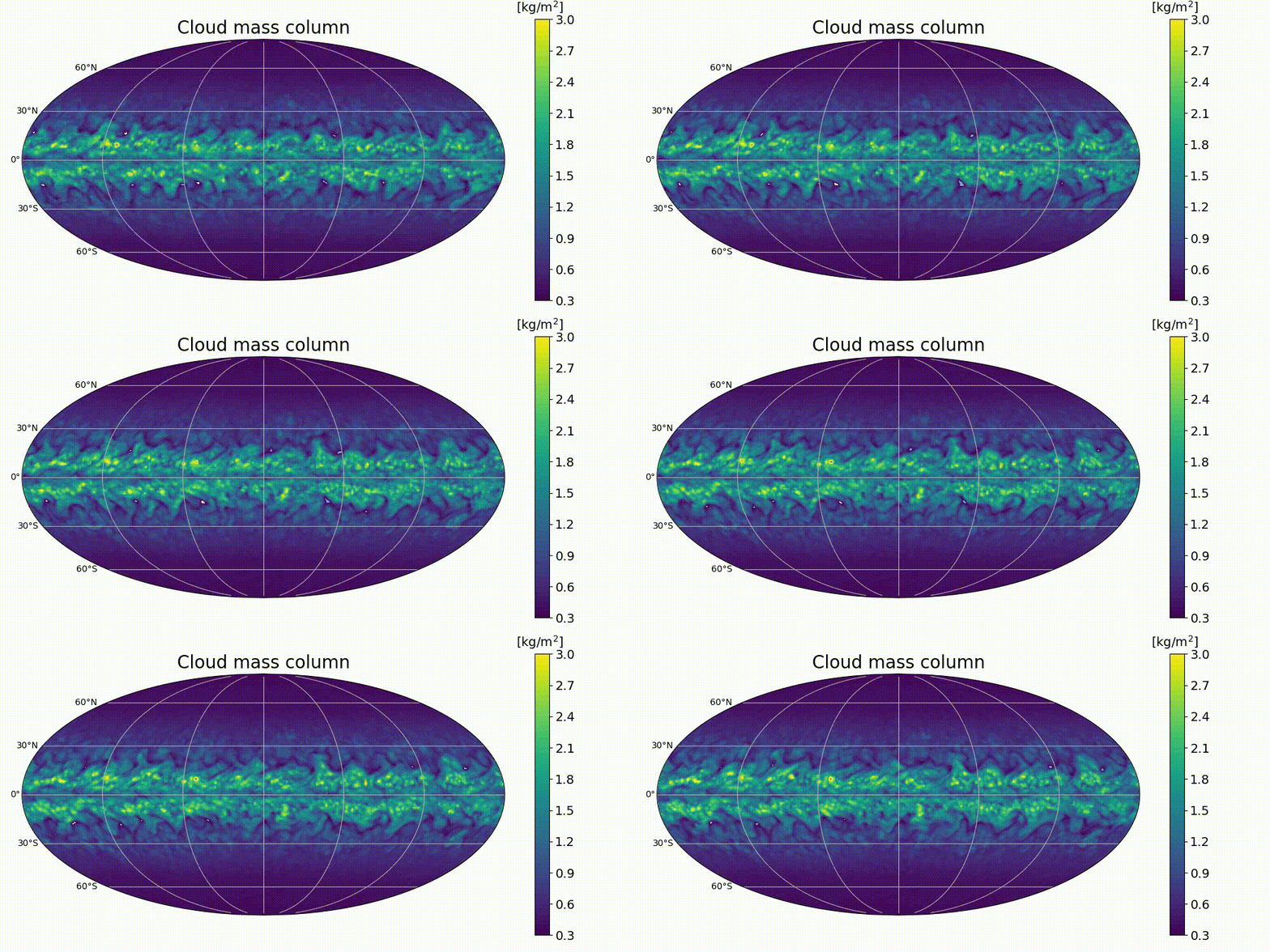
Until now, this transition had only been studied using one-dimensional atmospheric numerical models. Such models cannot properly account for atmospheric circulation, variations in cloud cover, and variability. Using a three-dimensional atmospheric model, similar to those used for Earth’s climate but adapted to hot atmospheres, researchers from the Paris Observatory – PSL, the CNRS, and Sorbonne University simulated the atmospheres of brown dwarfs with rock clouds at the L-T transition. They revealed that the clouds form a homogeneous but thicker layer at the equatorial band, in agreement with observations (see figure). The clouds heat the atmosphere through their greenhouse effect and generate convective motions and planetary waves. This heating and these atmospheric motions explain the rapid change in cloud altitude at the L-T transition as well as observations of variability. These 3D simulations explain other observations, such as the formation of strong westerly winds at the equator. They highlight the key role that clouds play in the overall atmospheric dynamics of brown dwarfs.
Towards a better understanding of exoplanetary atmospheres
This model could be applied to giant exoplanets observed by direct imaging, particularly to interpret future observations with the Extremely Large Telescope.
![<multi>[fr]Carte des nuages de roche, issue d'une simulation 3D de naine brune [en]Map of rock clouds, generated from a 3D simulation of a brown dwarf</multi>](IMG/png/nuageroche.png)
Reference :
This work will be published on January 19, 2026, in the journal Nature Astronomy under the title : “Clouds as the driver of variability and color changes in brown dwarf atmospheres” by L. Teinturier, B. Charnay, A. Spiga, and B. Bézard - https://www.nature.com/articles/s41550-025-02709-1