Discovered in 2025, 3I/ATLAS is the third interstellar object identified as passing through our Solar System, following 1I/‘Oumuamua and 2I/Borisov. Its hyperbolic orbit had already shown that it originated from interstellar space and, according to the new data, most likely from a stellar system located on the outskirts of our Galaxy.
When 3I/ATLAS made its closest approach to the Sun on 29 October 2025, the heat caused its ices to sublimate, releasing gases. Astronomers therefore used the James Webb Space Telescope’s NIRSpec spectrograph to study its coma in the infrared, whilst complementary observations by ALMA at millimetre wavelengths made it possible to characterise several volatile molecules and to consolidate the isotopic measurements that formed the basis for conclusions about its history and the environment in which it formed.
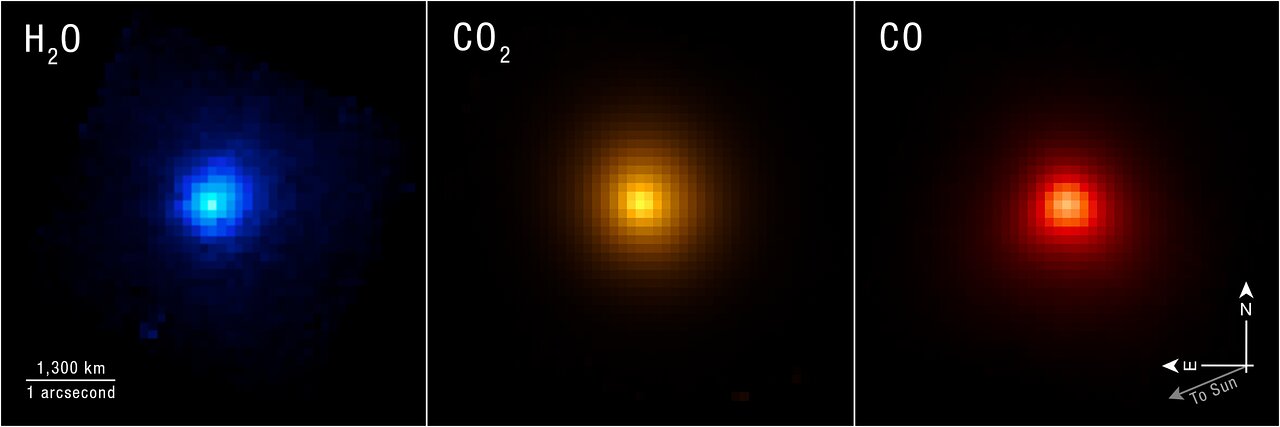
The results are spectacular : whilst the ingredients of this comet are the same as those of ‘ordinary’ comets in our Solar System – with no new molecules – it is their abundance ratios that differ. And, above all, the isotopic ratios.
A unique chemical signature : deuterium and carbon-13
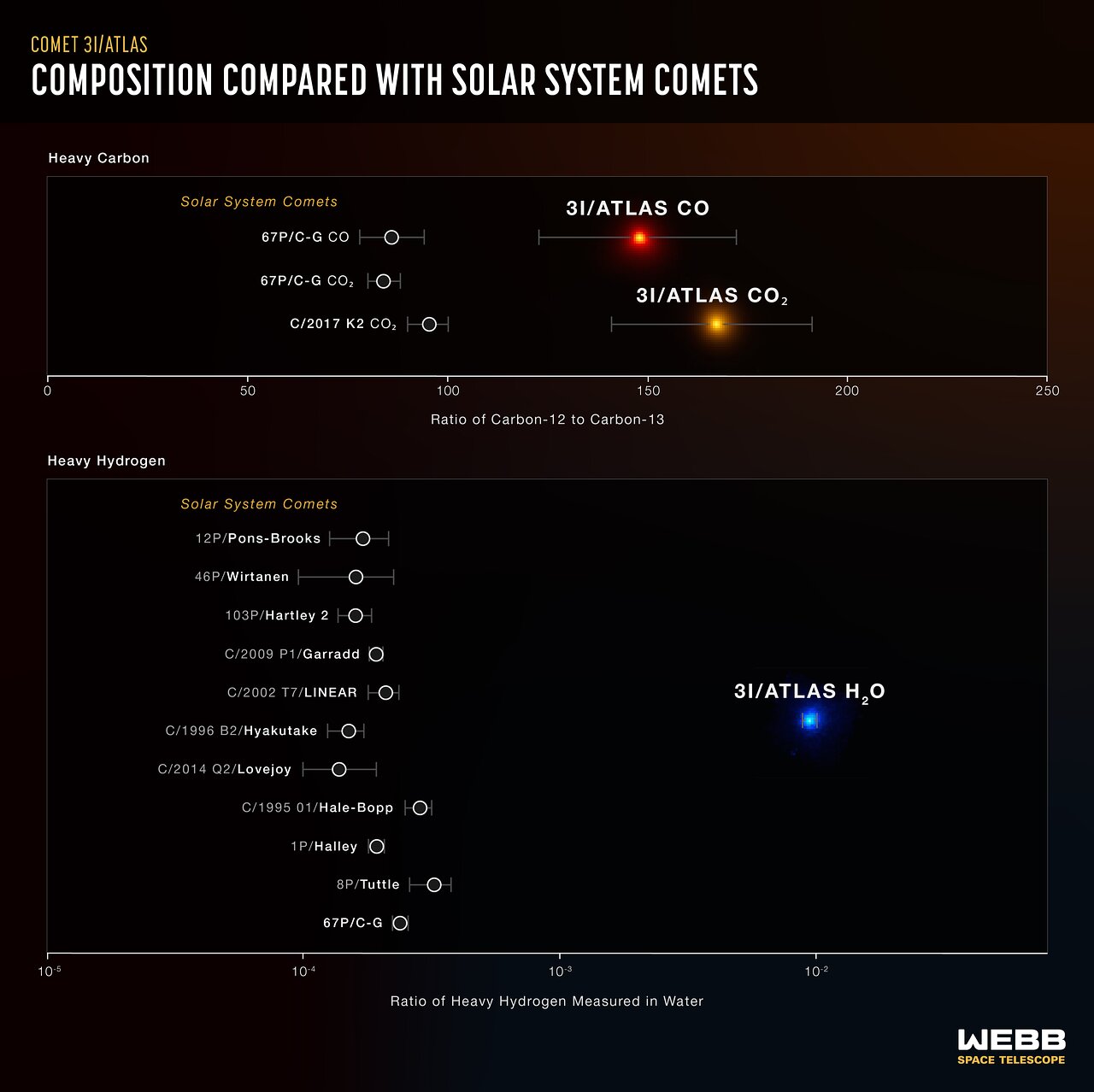
The various measurements carried out have revealed :
- Exceptionally high concentrations of deuterium, around 30 times higher than those observed in comets in the Solar System. This result suggests that 3I/ATLAS formed in an extremely cold environment, where the material was exposed to intense radiation but not to prolonged heat. Without this heat, the ‘heavy water’ ice (HDO, containing deuterium) could not have been transformed into water ice (H₂O) as we know it on Earth.
- Only traces of carbon-13 are present compared with the lighter carbon-12. This isotopic imbalance is a key marker of a very ancient origin : stellar systems become enriched in carbon-13 over time, as generations of stars are born and die within the galaxy. However, our Solar System, which formed 4.5 billion years ago, has much higher levels of carbon-13. This confirms that 3I/ATLAS originates from a much older system, when the Milky Way was still chemically under-enriched.
A journey spanning 10 to 12 billion years
Based on the isotopic measurements as a whole, researchers estimate that 3I/ATLAS formed 10 to 12 billion years ago, during the Universe’s ‘cosmic noon’ – a period in its history when star formation reached its peak. At that time, its parent system, still in its infancy, was probably nestled within a cold, dense cloud. The abundance of heavy water (HDO) indicates that the comet spent its early years in a state of deep freeze, thereby preserving its primordial chemical composition.
A true cosmic fossil
After being ejected from its home system, the comet is thought to have travelled for billions of years through interstellar space before crossing the Sun’s path.
The discovery of its composition raises fundamental questions about whether the conditions conducive to the emergence of life in our Galaxy are rare or commonplace. Indeed, comets such as 3I/ATLAS are regarded as time capsules : they carry material that has remained intact since their formation, thus providing direct evidence of the chemical processes at work in distant stellar systems during that distant era, several billion years before the birth of the Sun and the planets of the Solar System.
Contributions from the Paris Observatory – PSL
The study published in Nature involves a broad international collaboration including three researchers from the Paris Observatory - PSL at the Laboratory of Instrumentation and Research in Astrophysics :
- Nicolas Biver, CNRS researcher
- Dominique Bockelee-Morvan, CNRS researcher
- Jacques Crovisier, astronomer at the Paris Observatory - PSL
Find out more
The article “When the MAJIS instrument, aboard the JUICE mission, crosses paths with the interstellar traveller 3I/ATLAS”