MOONS was built by an international consortium led by the UK Astronomy Technology Centre (UK ATC) at the Royal Observatory Edinburgh, involving collaboration across six countries. This project marks a significant milestone for French science and engineering, particularly through the development of new expertise in using fibres in cryogenic environments—a responsibility led by France.
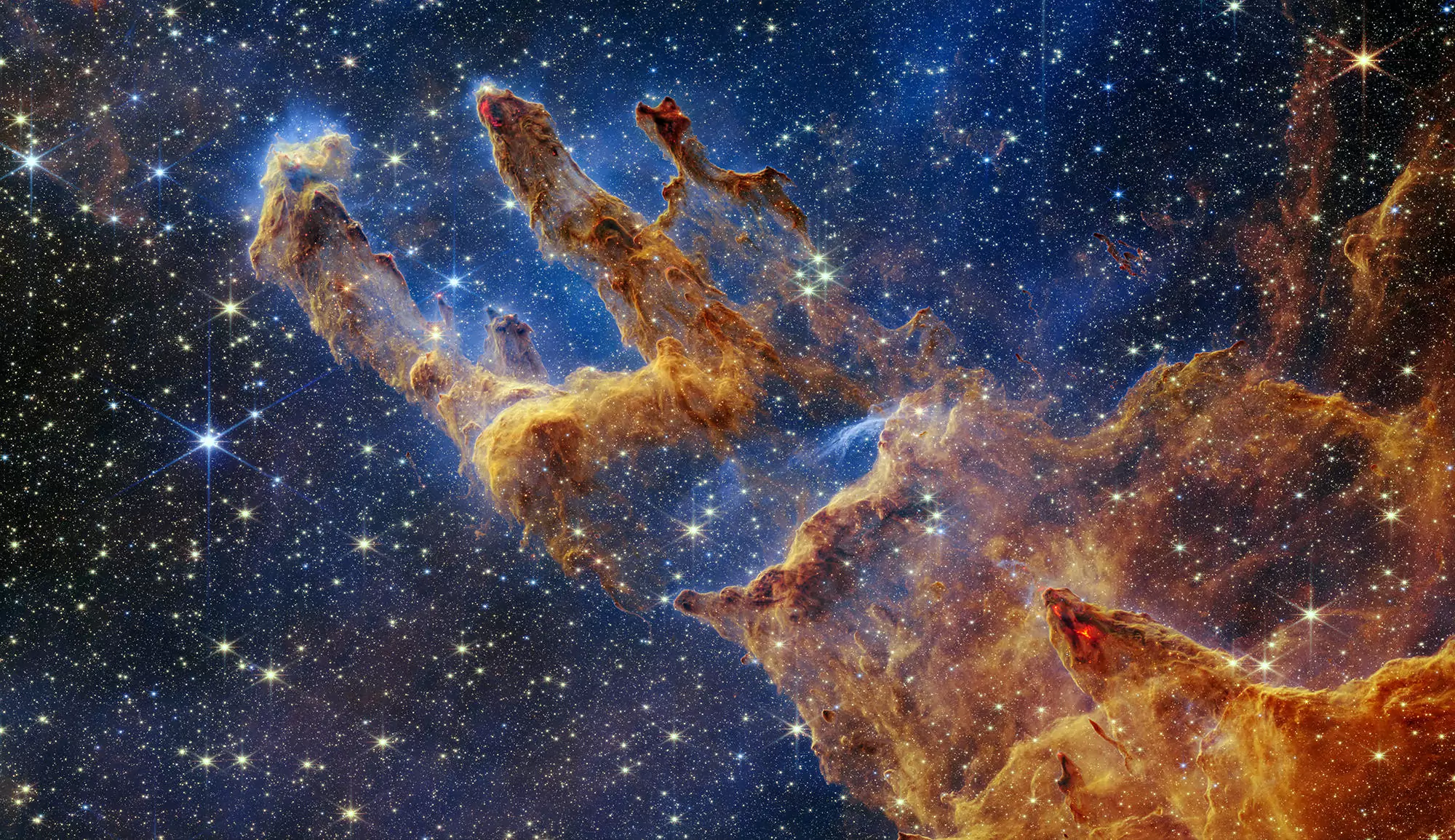
This next-generation instrument will transform our understanding of the Universe by capturing light from up to 1,000 celestial objects at once. It will pave the way for revolutionary discoveries about the formation and evolution of galaxies throughout cosmic history.
Its journey to Chile marks the final stage before its integration into ESO’s Very Large Telescope (VLT) and its first use in 2026.
10 tons of precision engineering
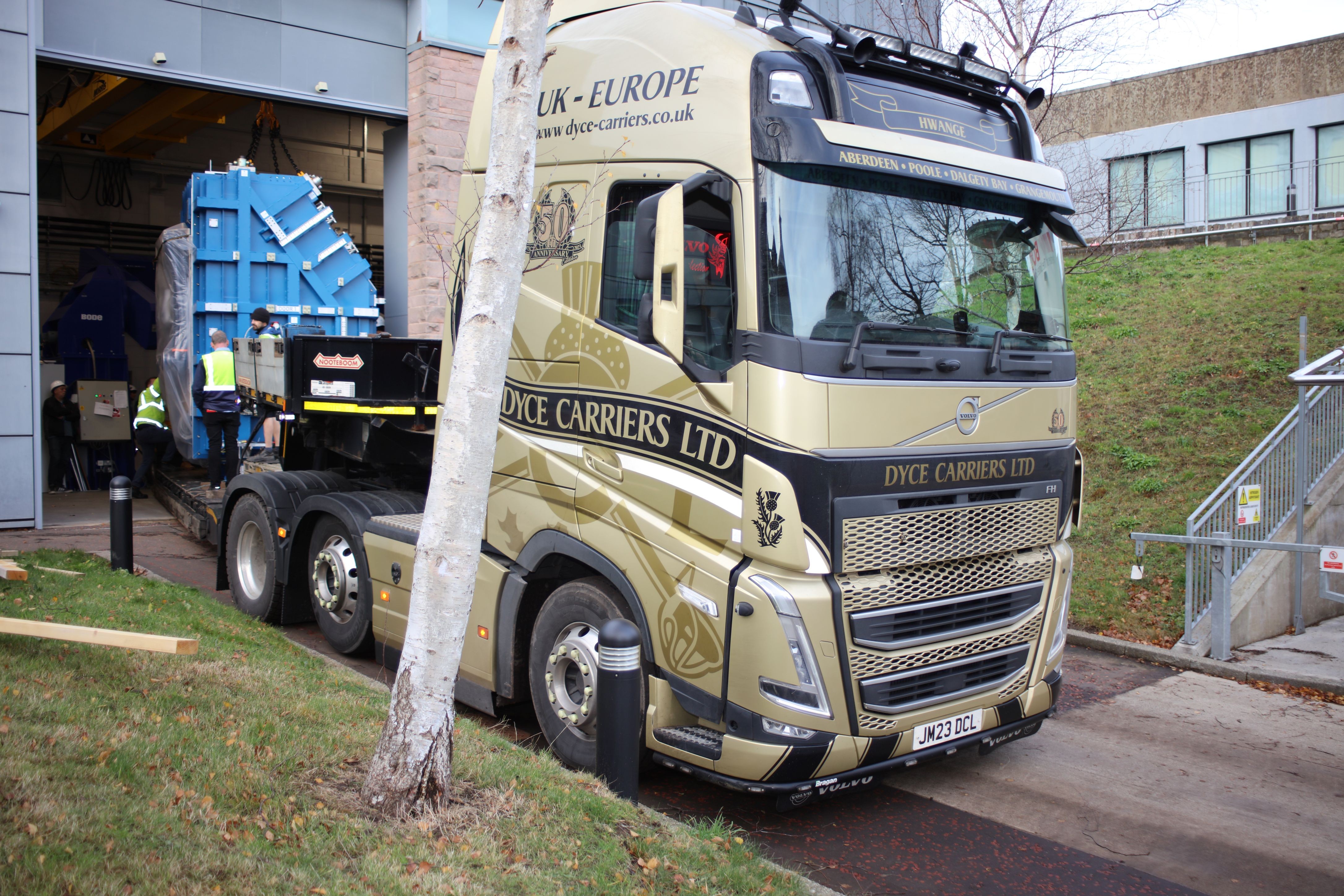
Standing at 4.5 metres tall and weighing 10 tonnes, MOONS is one of the largest and most complex astronomical instrument ever constructed in Europe. The instrument was successfully packed and loaded onto a truck at the UK Astronomy Technology Centre’s Royal Observatory Edinburgh site.
It was a complex and delicate operation to ensure that MOONS arrived safely at one of the most advanced astronomical facilities in the world.
The equipment was carefully packed into 15 custom made crates, with the packaging alone weighing 4 tonnes. Three articulated trucks were loaded using a forklift and crane and then transported to Southampton. The last unit to leave the UK ATC was also the largest (the 7tonne spectrograph). It will stop in Glasgow, where it will be carefully turned on its side and packed in a specialized facility.
An 11,000 km journey to the stars
All the crates will be loaded into a single huge container, which will be shipped from Southampton to begin its 11,000 km sea voyage to South America. Upon arrival in Chile in January 2026, it will travel the final 560 km by road to ESO’s VLT site in the mountains. Once at Paranal, the instrument will undergo a five-month integration process, paving the way for the first observations in the summer of 2026, after years of work and dedication.
An international project
MOONS is a collaborative initiative led by UK ATC and involving partners from six countries (the United Kingdom, Italy, France, Portugal, Switzerland, and Chile) as well as ESO.
UK ATC has led the project, which has been supported from the outset by CNRS-INSU and the Paris Observatory-PSL. Within the consortium, France has been responsible for the fibre link, the slit environment, the shutter, and the data reduction pipeline.
Its unique capabilities will enable astronomers to study millions of stars and galaxies, providing unprecedented data on the formation and evolution of galaxies and the structure of our Milky Way. This will help answer some of the biggest questions in astronomy.
Un voyage de 11 000 km vers les étoiles
Toutes les caisses seront chargées dans un seul énorme container, embarqué sur un navire à Southampton pour commencer son voyage maritime de 11 000 km vers l’Amérique du Sud. À son arrivée au Chili en janvier 2026, il effectuera les 560 derniers kilomètres par la route jusqu’au site du VLT de l’ESO dans les montagnes. Une fois à Paranal, l’instrument sera soumis à un processus d’intégration de cinq mois qui ouvrira la voie aux premières observations à l’été 2026, après des années de travail et de dévouement.
Un projet international
MOONS est une initiative collaborative menée par UK ATC et impliquant des partenaires de six pays (Royaume-Uni, Italie, France, Portugal, Suisse et Chili) ainsi que l’ESO.
UK ATC a piloté le projet, qui a été soutenu depuis le début par le CNRS-INSU et l’Observatoire de Paris-PSL. Au sein du consortium, la France a été responsable du lien fibre, de l’environnement fente, de l’obturateur et du pipeline de réduction de données (Frédéric ROYER, LIRA, Observatoire de Paris-PSL, CNRS).
Ses capacités uniques permettront aux astronomes d’étudier des millions d’étoiles et de galaxies, fournissant des données sans précédent pour étudier la formation et l’évolution des galaxies et la structure de notre propre Voie lactée, contribuant ainsi à répondre à certaines des plus grandes questions de l’astronomie.