Generally, magnetic ApBp stars are studied by spectropolarimety. Observations show that the atmospheres of these stars possess strong abundance anomalies (metal abundances that are several orders of magnitude larger than cosmic abundances are often found, underabundances can also occur). These abundance anomalies are inhomogeneously distributed over the surface. Mapping of magnetic structures and of abundances is obtained by Zeeman-Doppler imaging. Although the current precision of this imaging technic is insufficient for a detailed study, the existence of structures is recognized. Several works show also a dependence of these structures with depth.
How to explain these peculiarities ?
The only mechanism known to explain such anomalies is abundance stratification by atomic diffusion (Michaud, 1970). Among main sequence stars, ApBp stars are those having the most stable atmosphere (stability is a required condition for a significant effect due to atomic diffusion to take place). Although atomic diffusion is a physical process resulting from first principles and is well understood, its modelling is very complex for stellar atmospheres (more complex than for stellar interiors). The reasons are : Diffusion velocities are strongly dependent on the radiative accelerations, computation of which requires large quantities of atomic data. Those data are lacking for some elements (like rare earths). The computation of radiative accelerations requires to solve in detail the polarized radiation transfer equation, with hundreds of thousands of atomic transitions (observed or not), in the range 900-10000A, with resolution of 0.01A, estimating the Zeeman desaturation, and tacking into account the blending effect. The time-dependent stratification mechanism is a non-linear and non-local function of the considered element distribution through the atmosphere. This stratification process is very slow and then extremely sensitive to any perturbation in the medium.
The 2D equilibrium stratification model
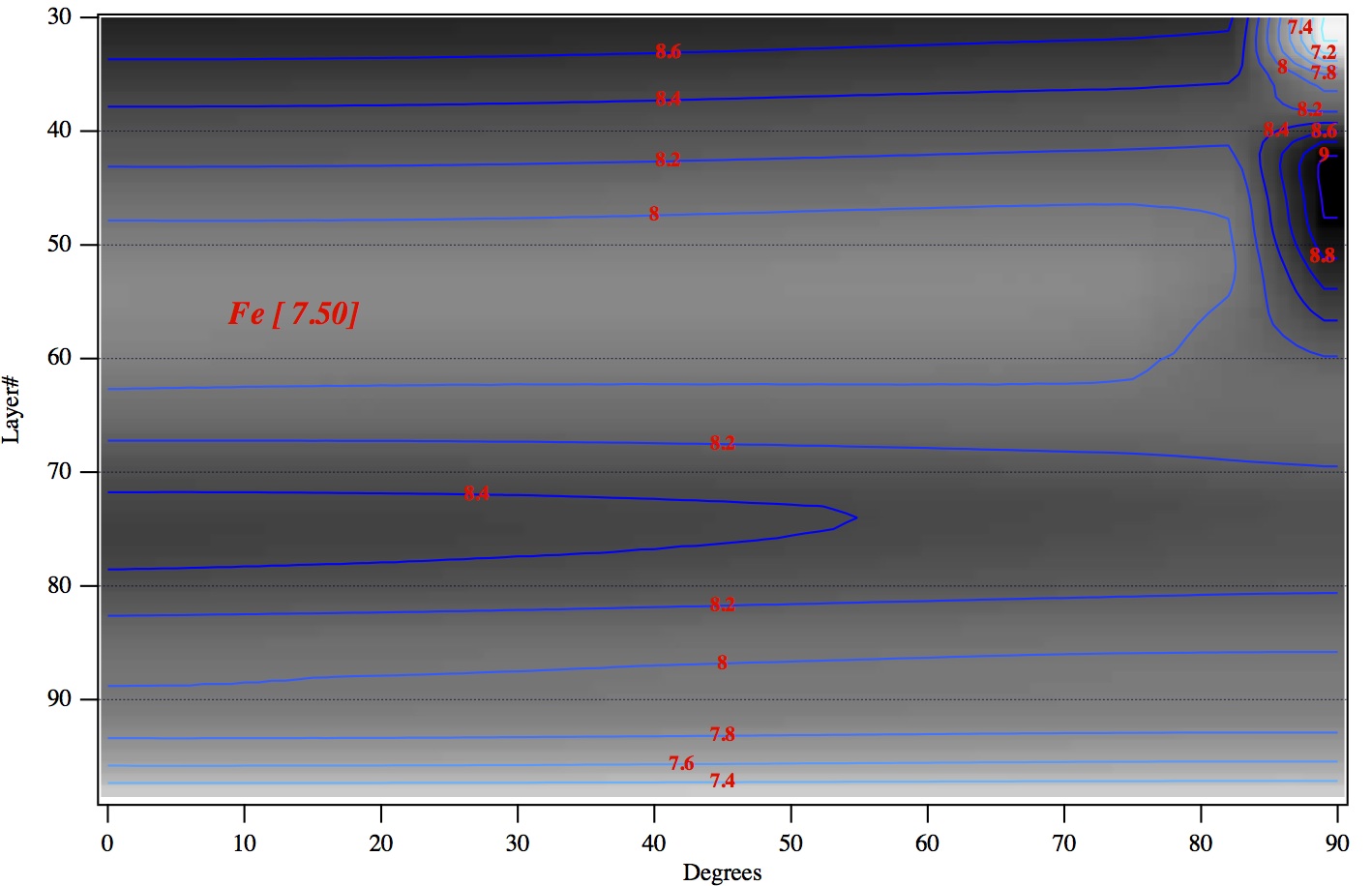
A realistic calculation of the formation of such clouds is not conceivable presently. This type of calculation needs still some theoretical and numerical developments, and very important computer resources. However, an approximate modelling may be carried out at a reasonable price. One can, for instance, estimate the shape of those clouds, assuming that the process has reached an equilibrium stage (Alecian & Stift 2010, LeBlanc et al 2009). This kind of calculation (Figure 1) requires more than 6000H monoprocessor CPU on the SGI machine (Jade) at CINES. Figure 1 presents a 2D cut in the atmosphere of a magnetic Bp star. The iron abundance at equilibrium is shown along the magnetic meridian (bottom axis), for a simple dipolar geometry. One can notice a strong enhancement of the Fe abundance close to the magnetic equator and at an optical depth of 0.01. Because the geometry of the field is strictly dipolar, the cloud forms a belt around the star. Figure 2, gives a schematic view of such a star.

First numerical simulations of the cloud build-up
Although detailed descriptions of the formation of these clouds are presently out of reach, a recent work (Alecian et al. 2011) allowed to progress in the understanding of this phenomenon, and to have a better idea of the clouds behaviour. For this purpose, the authors considered a fictitious element (the "cloudium") whose the atomic properties were inspired from those of mercury, and shaped to allow much faster computation. This numerical simulation of atomic diffusion in a stellar atmosphere (the first one ever done) allows establishing a realistic order of magnitude of the characteristic time of the clouds build-up, and shows two essential behaviours : In many cases the equilibrium state will never been reached. The hypothesis of a cyclic or chaotic build-up of these clouds is strengthened.
