

Whilst the metallicity (or chemical composition of the environment) is an
important factor on the stellar evolution of Be stars and on their
rotational velocity (see the previous
news on the Be stars), other phenomenon like pulsations could help to
eject matter. Thanks to the possibilities offered by ESO’s VLT, and the GIRAFFE
multi-object spectrograph in MEDUSA mode,
and thanks to the photometric databases OGLE
et MACHO, a team of astronomers
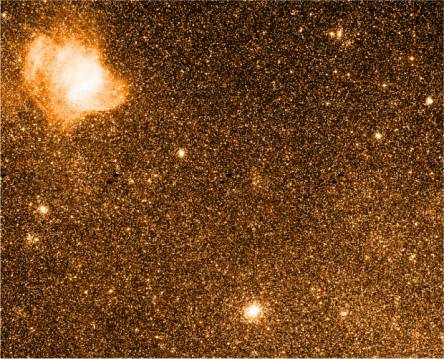
at the Observatoire de Paris (GEPI) observed 350 hot stars (O, B, Be) in
an area of the metal-poor galaxy Small Magellanic Cloud (figure
1) close to the open cluster NGC330. The study of their spectra and lightcurves allowed to discover new binary systems, to find that
the size of a large fraction of the Be stars disks are bigger in faint metallicity environment,
and to detect for the first time pulsations in 13 Be stars of the Small
Magellanic Cloud.
The use of spectra allows to find indirectly that, in
the frame of Keplerian rotation mode (like planets around the Sun) the disks
of a large fraction of Be stars in the Small Magellanic Cloud are larger than in the Large
Magellanic Cloud and in the Milky Way.
The use of spectra allows to find indirectly that, in
the frame of Keplerian rotation mode (like planets around the Sun) the disks
of a large fraction of Be stars in the Small Magellanic Cloud are larger than in the Large
Magellanic Cloud and in the Milky Way.
Moreover, it seems that the proportion of Be stars
to B stars is higher in the Small Magellanic Cloud than in the Large
Magellanic Cloud and in the Milky Way. This result could be linked to
the stellar rotational velocities higher in low metallicity area (Small
Magellanic Cloud) than at higher metallicity (Large Magellanic Cloud and
Milky Way). This result will be extended to the whole field of these galaxies.
Moreover, it seems that the proportion of Be stars
to B stars is higher in the Small Magellanic Cloud than in the Large
Magellanic Cloud and in the Milky Way. This result could be linked to
the stellar rotational velocities higher in low metallicity area (Small
Magellanic Cloud) than at higher metallicity (Large Magellanic Cloud and
Milky Way). This result will be extended to the whole field of these galaxies.

The combined use of spectra and lightcurves from the
photometric surveys MACHO and
OGLE allows to discover new
binary systems of stars in the Small Magellanic Cloud. In figure 2,
an example of binary system is shown. It also shows the
spectral lines of the 2 components of this binary system at 2 different
epochs. Moreover it shows the lightcurves for this system and
their mutual eclipses as time passes. The detected binaries will be
used in a forthcoming study in order to determine the effect of the
metallicity on the stellar radii and to precise the distance of the
Small Magellanic Cloud.
The combined use of spectra and lightcurves from the
photometric surveys MACHO and
OGLE allows to discover new
binary systems of stars in the Small Magellanic Cloud. In figure 2,
an example of binary system is shown. It also shows the
spectral lines of the 2 components of this binary system at 2 different
epochs. Moreover it shows the lightcurves for this system and
their mutual eclipses as time passes. The detected binaries will be
used in a forthcoming study in order to determine the effect of the
metallicity on the stellar radii and to precise the distance of the
Small Magellanic Cloud. The lightcurves have also allowed us to find short-term variability in 13 Be stars, i.e. in 10% of the sample of Be stars that were observed in the Small Magellanic Cloud. Among these 13 stars, 9 show several short-term periods of variation, which plaids in favor of non-radial pulsations in these stars (see figure 3). These pulsations combined to the high stellar rotational velocities of stars could allow the ejection of matter at the origin of the Be stars’ disks. However, the theoretical models did not foresee the existence of pulsations at low metallicity, typically in the Small Magellanic Cloud.

In conclusion, while fast rotation plays a fundamental role in the appearance of Be stars, a role even more important in low metallicity environments, it is not always sufficient to allow matter ejections. Other phenomena combined with rotation, such as the presence of a magnetic field or non-radial pulsations, could favour the creation of the circumstellar envelope of Be stars.