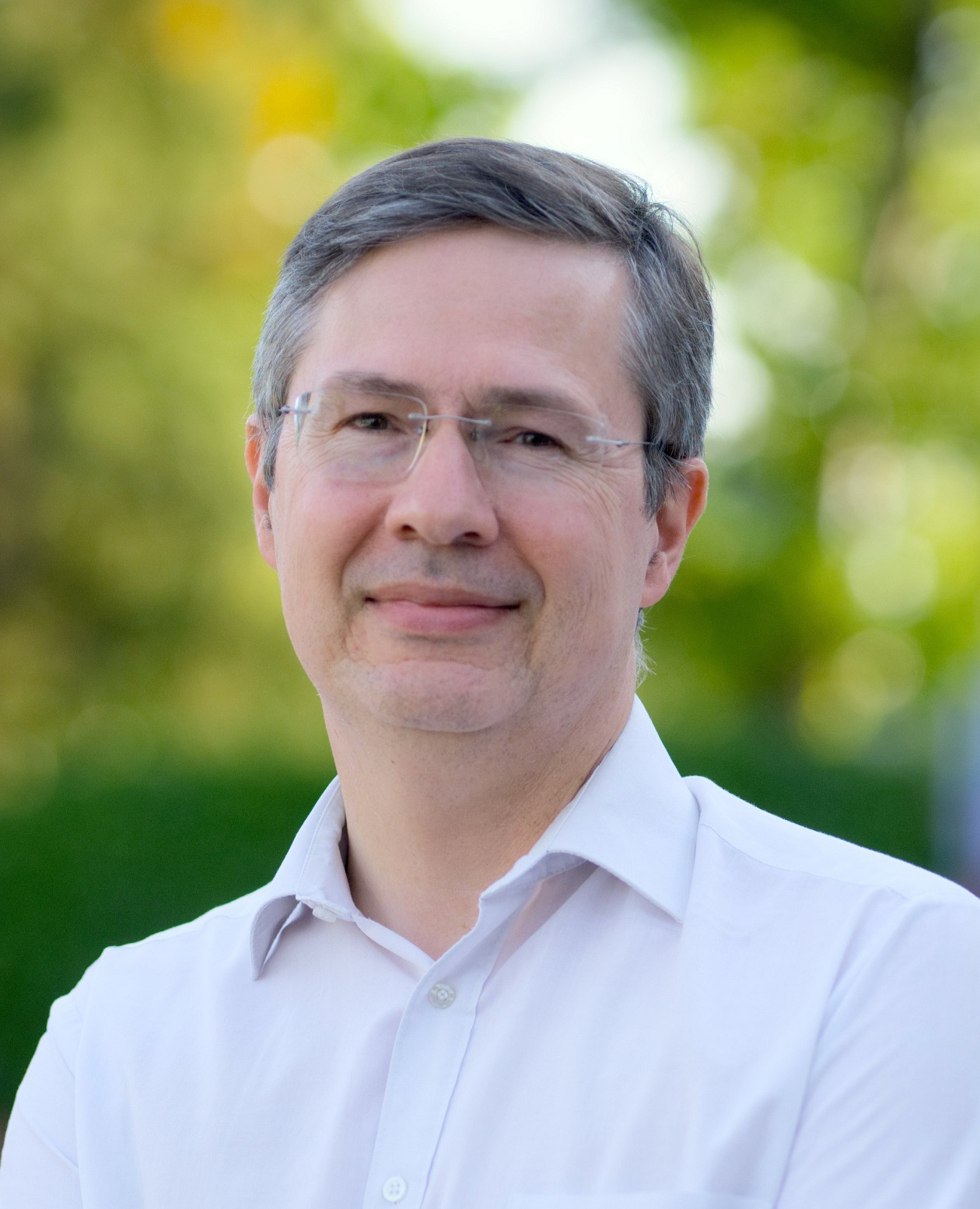
Pierre Kervella is an astronomer at the Paris Observatory. He has been involved in optical interferometry since completing his PhD in 2001, during the European VLT’s early days in this field, for which he bore a major share of responsibility whilst in Chile.
The aim was to explore an entirely new field : coherently coupling four 8.2-metre telescopes, then making the specialised instrumentation available to the scientific community, thereby opening up remarkable prospects in terms of angular resolution.
He subsequently became a world-renowned expert in high-resolution imaging and precision astrometry, applied to stars and exoplanets.
With his masterful command of observational techniques, he produced new, high-precision results on binary and giant stars, as well as the first measurement of the flattening of a rapidly rotating star (Achernar).
In a second phase, he explored in greater depth a problem that is absolutely fundamental to the whole field of astrophysics : the absolute calibration of distances, based on the canonical relationship between the mass and luminosity of Cepheid pulsating stars.
The contribution of interferometry lies in directly measuring the stellar diameter and its variation during pulsations : highlighting a series of biases (binarity, centre-to-edge variations in brightness, pulsation velocities determined by spectroscopy, dust envelopes), he radically improves the precision of the distance scale, reducing it to 1%, compared with the 5% that had previously been the norm. The locally measured Hubble constant H₀, derived from these measurements, is at odds with that obtained from observations of the cosmic microwave background, and with the predictions of the Standard Model.
Together with his student, L. Breuval, he also proposed a unique approach to refine the parallaxes of Cepheid variables using those of their close companions, a method which led to a reassessment of the Hubble constant and confirmation of the discrepancy, now referred to as the ‘Hubble tension’. The international impact of this work is therefore remarkable, and has enabled him to secure an ERC Synergy grant, as well as the Franco-Polish Marie Skłodowska-Curie and Pierre Curie Prize in 2022.
With his curious and open-minded approach, his work in astrometry has expanded in recent years with the arrival of the GRAVITY instrument at the VLTI – in which he plays a leading role – and with the European GAIA space mission. Thanks to GAIA’s results, he has identified tens of thousands of stars exhibiting anomalous proper motions, suggesting the presence of planets.
He has also shed light on the cause of Betelgeuse’s dimming in 2020 by identifying the presence of a dust envelope.
Our warmest congratulations to Pierre Kervella.