Ariel is the M4 mission of ESA’s “Cosmic Vision” program, scheduled for launch in 2032. It is a mission entirely dedicated to studying the atmospheres of exoplanets : over the course of four years, it will examine approximately 1,000 exoplanets.
France is making a major contribution by providing one of its instruments, the infrared spectrometer known as AIRS (ARIEL Infra-Red Spectrometer), under the project management of CNES.
In March 2026, the engineering model of the AIRS infrared spectrometer arrived at the Paris Observatory – PSL, on the Meudon campus, for thermal testing of the cold section and instrument calibrations.
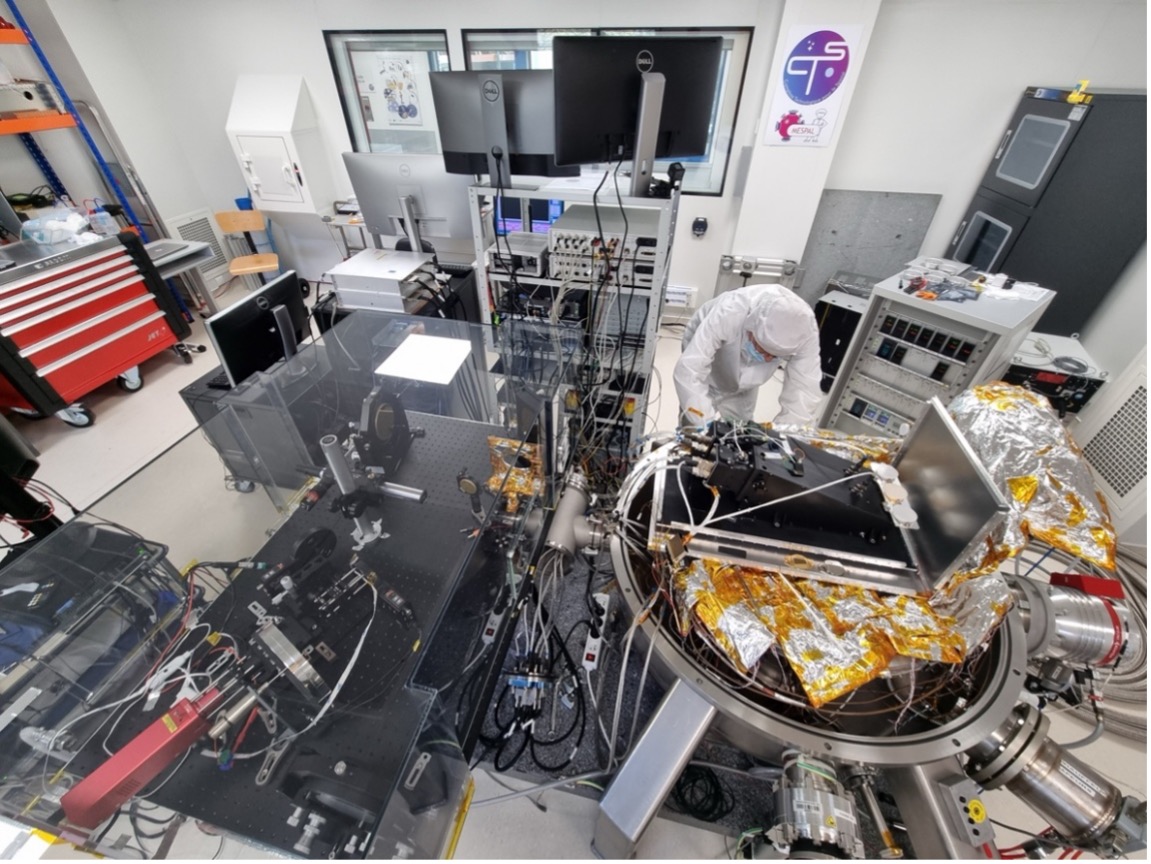
This engineering model is installed at the Laboratory of Instrumentation and Research in Astrophysics (LIRA) in the cryogenic vacuum chamber, SimEnOm—a chamber designed to replicate conditions similar to those in space and verify the instrument’s proper functioning.
LIRA is responsible for this entire test campaign : it provides the equipment—including an optical bench that simulates the telescope—and performs all measurements to evaluate the instrument’s performance.
A New Milestone for AIRS
To verify the performance of the AIRS instrument, a measurement was taken through a cell containing gaseous methane. Methane is an organic compound present in Earth’s atmosphere that is expected to be found on exoplanets observed with ARIEL.
The positions of methane’s spectral lines are precisely known and allow us to verify that the instrument responds as expected when it detects them.
The measurement is very simple. It involves taking two acquisitions with AIRS :
- the first with methane,
- and the second without methane, which serves as a reference.
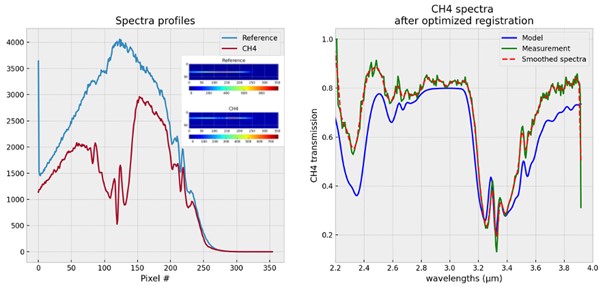
By calculating the ratio of the two measurements, we can compare the methane spectrum obtained with AIRS to a theoretical model.
These tests will continue through November 2026, with the participation of scientific teams from the CEA, the IAS, and the IAP.
Once this phase is complete, the instrument will be delivered to the Rutherford Appleton Laboratory (RAL) in the United Kingdom for further testing with all of ARIEL’s integrated systems.
The development of the AIRS infrared spectrometer is being led by CEA-Irfu (Department of Astrophysics, UMR AIM), with major contributions from :
- the IAS (Institute of Space Astrophysics),
- the LIRA (Laboratory of Instrumentation for Astrophysical Research)
- and the LAB (Bordeaux Astrophysics Laboratory).
CNES serves as the project owner.
The IAP (Paris Institute of Astrophysics) and the LISA (Interuniversity Laboratory for Atmospheric Systems) will also contribute to the scientific preparation of the mission through simulations and data processing chains.
For more information :
On the LIRA website : First light for the French AIRS instrument on the ARIEL mission