MOONS (Multi-Object Optical and Near-infrared Spectrograph) is a state-of-the-art multi-object spectrograph installed at the VLT’s Nasmyth focus. Led by the United Kingdom, the project brings together partners from six countries — the United Kingdom, Italy, France, Portugal, Switzerland and Chile — as well as ESO. Since the early stages of the project, the Paris Observatory – PSL and the CNRS have made a major contribution.

After more than a decade of design, development, assembly and testing in the UK, at the Royal Observatory Edinburgh (Astronomy Technology Centre), MOONS left the UK in December 2025 to travel to the Paranal site in Chile, after a journey of some 11,000 kilometres. Now integrated into the VLT, it has just carried out its first observations, with particularly promising results.

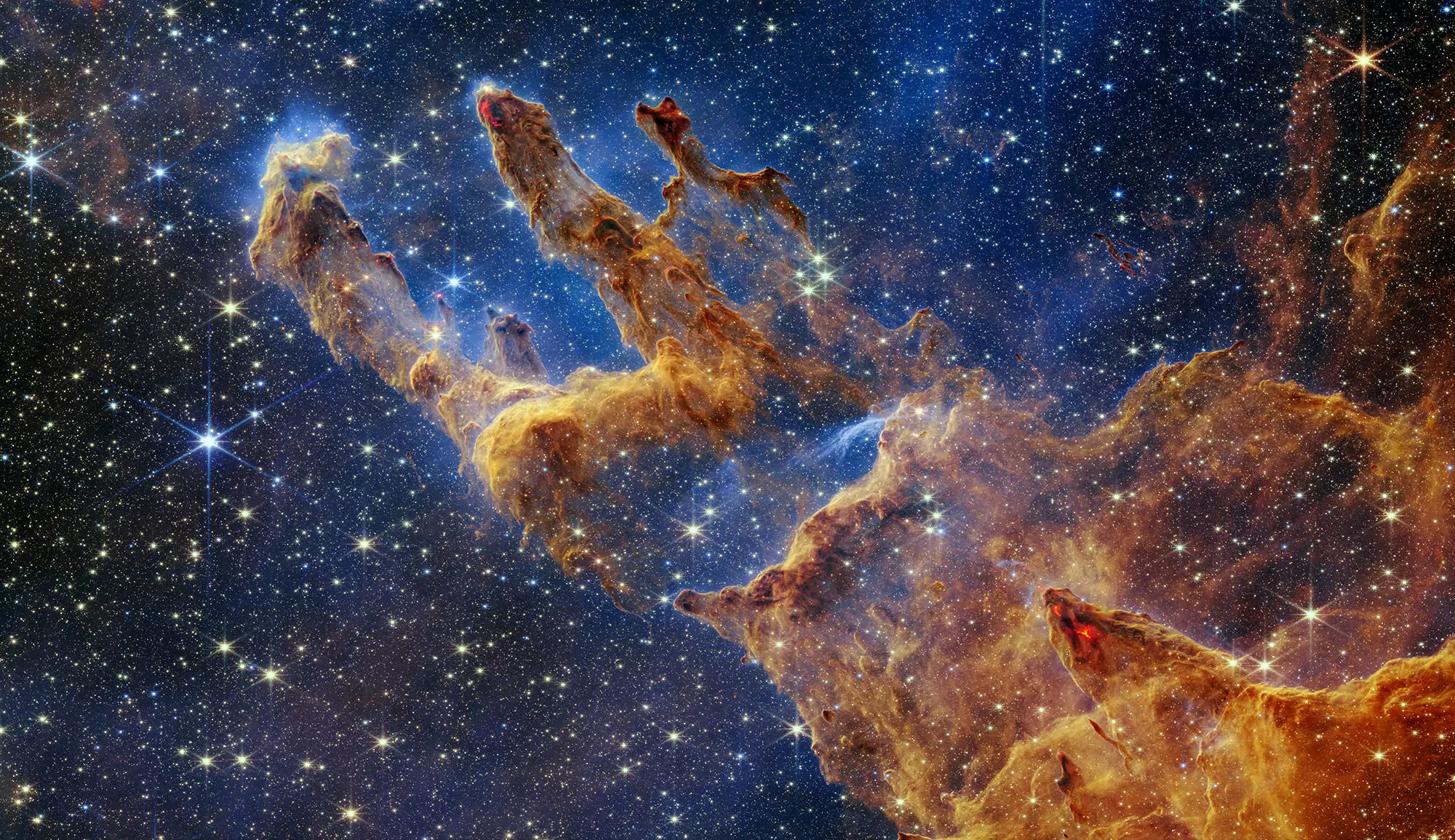
These observations have, in particular, made it possible to target stars located in the plane of the Milky Way, behind thick clouds of cosmic dust. This is because MOONS’ unique feature is its ability to observe in the infrared. It can effectively ‘see’ through this dust and explore regions that were previously difficult to access. Its performance in terms of multiplexing, sensitivity, spectral quality and wavelength coverage has also been brilliantly demonstrated.
A French contribution at the heart of the instrument
A technological marvel weighing 10 tonnes and standing 4.5 metres tall, MOONS is the largest spectrograph ever built in Europe.
With some 1,000 optical fibres, each controlled by a robotic positioner, MOONS can simultaneously observe nearly a thousand targets across a vast field of view. The light is then channelled to two identical spectrographs (each comprising 500 fibres) cooled to very low temperatures (between –143°C and –233°C), in order to minimise spurious infrared emissions. The cryostat, which requires some 5,000 litres of liquid nitrogen, is, in fact, one of the largest ever built for a ground-based astronomical instrument. Once broken down in this way, the light reveals to astronomers numerous properties inherent to cosmic objects, such as their chemical composition, mass and velocity.


In this technological feat, France was responsible for several key components: the fibre-optic link, the slit environment, the shutter and the data reduction pipeline. These developments have, in particular, enabled teams at the Paris Observatory – PSL and the CNRS to acquire cutting-edge expertise in the use of fibres in cryogenic environments.
Ultimately, MOONS will enable us to obtain the spectra of millions of stars and galaxies. Not only will it open a new window onto the formation and evolution of galaxies throughout the history of the Universe – including its expansion, with the most distant galaxies receding from us more rapidly and their light shifted towards longer wavelengths, mainly in the infrared – but it will also provide an unprecedented map of our own Milky Way.
After fourteen years of innovation, international cooperation and engineering of the highest calibre, MOONS’ first light thus marks the culmination of a major scientific and technological endeavour for the Paris Observatory – PSL and the CNRS. The new instrument, now the largest of its kind, joins the family of benchmark spectrographs for ground-based telescopes, alongside MUSE, X-shooter and 4MOST in particular, and ushers in a new era for multi-object spectroscopy in the near-infrared.
Composition of the international consortium
The MOONS instrument was designed and built by a consortium of European and Chilean universities and research institutes, namely:
- The Science and Technology Facilities Council’s UK Astronomy Technology Centre (UK ATC), United Kingdom (consortium lead)
- Centro de Astro-ingenieria UC (AIUC), Pontificia Universidad Católica de Chile, Chile
- ETH Zürich, Switzerland
- The Paris Observatory – PSL and the CNRS, France
- INAF, Italy
- Institute of Astronomy (IoA), University of Cambridge, United Kingdom
- Instituto de Astrofísica e Ciências do Espaço (IA), Portugal
- University of Geneva, Switzerland
ESO is an associate member of the consortium and has provided the high-sensitivity scientific detection systems used by MOONS.