BepiColombo : Another Decisive Step Toward Mercury
Thursday, September 3, 2026, will go down as a major milestone in the exploration of the Solar System. Eight years after the probe’s launch from Kourou, the MTM (Mercury Transfer Module), which carried the two scientific probes, MPO and Mio, separated from MPO, to which it had been attached since assembly.
The separation took place at 2:00 p.m. Paris time.
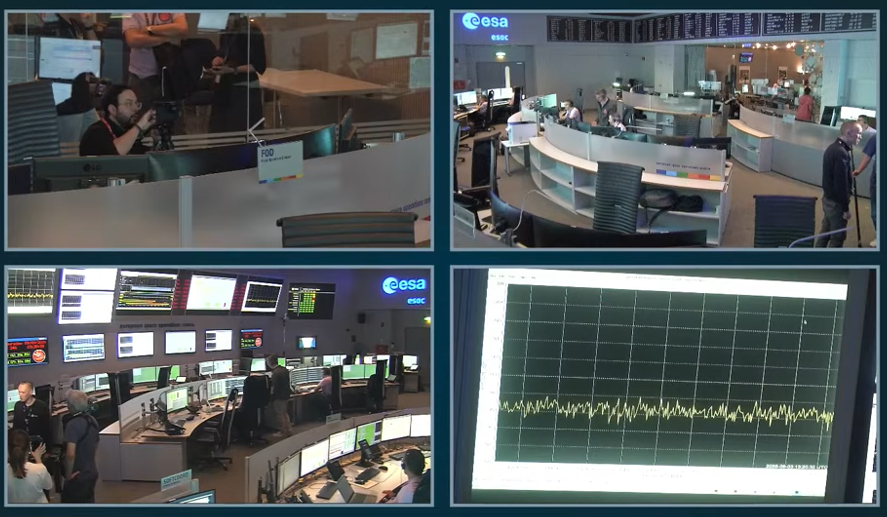
The MTM had no means of communicating directly with Earth. Engineers at the ESA operations center in Darmstadt, Germany, were therefore waiting for the first signal transmitted by the MPO to confirm the successful separation of the two spacecraft at approximately 3:53 p.m.
BepiColombo is the first European mission to Mercury, conducted jointly by ESA and JAXA. Launched in 2018, it carries two scientific probes :
- ESA’s Mercury Planetary Orbiter (MPO)
- and JAXA’s Mercury Magnetospheric Orbiter (Mio).
These probes will study Mercury’s surface, internal structure, magnetic field, and environment. The European Mercury Transfer Module (MTM) successfully transported them to Mercury. After an eight-year journey, the mission is scheduled to reach the planet in November 2026, with scientific operations set to begin in April 2027.
A historic moment witnessed from Leuven, Belgium
Scientists from the Paris Observatory - PSL who are studying the planet Mercury had gathered at the Catholic University of Leuven (KU Leuven, Belgium) for the Mercury 2026 conference. On the afternoon of September 3, tension and excitement ran high in the historic conference hall where live coverage of the event was being projected.
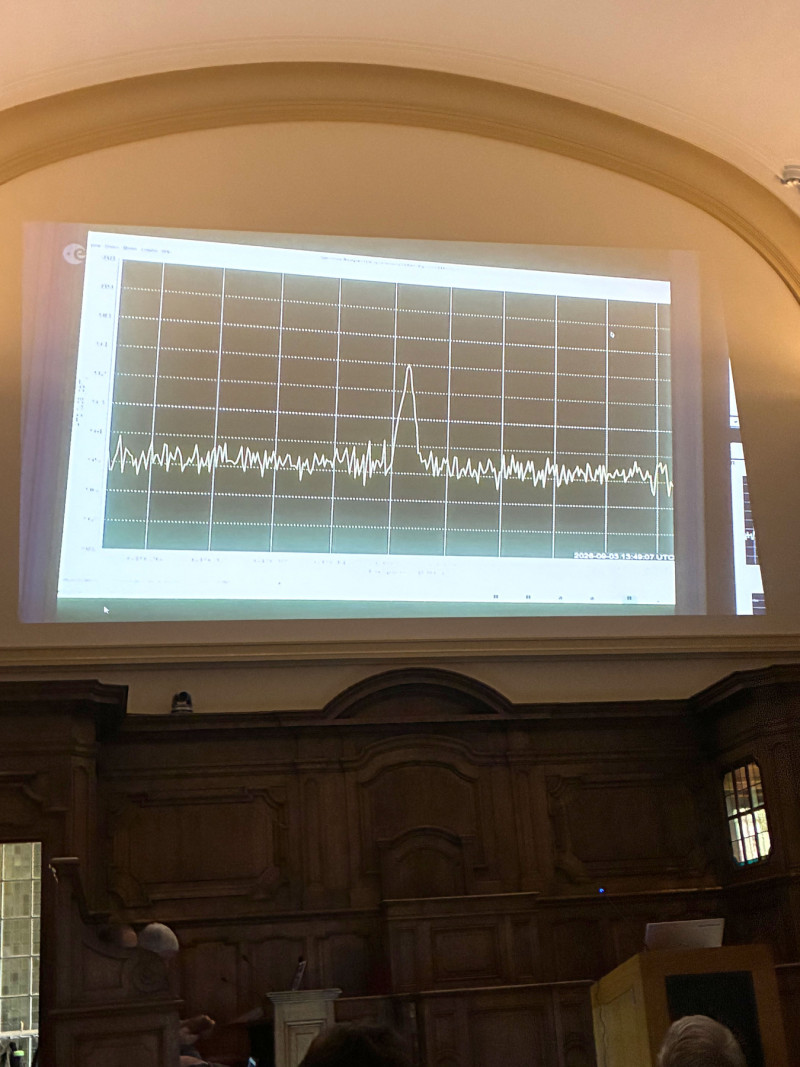
When the image from the signal appeared on the wall (a few minutes ahead of schedule), applause rang out in the room, along with a huge sense of relief : most of the researchers present have been working on BepiColombo for over ten years ! Some have even been following the project since its first presentation to ESA... in 2004 !
Two Spacecraft to Explore an Extraordinary Planet
This is the first time in history that two spacecraft will be deployed simultaneously around another planet—in this case, one of the most difficult to reach : Mercury.
The BepiColombo mission has already broken several records, including the closest flyby of a planetary surface at an altitude of 164 kilometers during the 4th flyby of Mercury on September 4, 2024.
LIRA at the Heart of the Mission
The LIRA at the Paris Observatory - PSL is responsible for two instruments, one on each of the two probes :
- SORBET (PI : K. Issautier), the high-frequency radio receiver of the “Plasma Wave Instrument” suite aboard Mio (the Japanese probe) ;
- and VIHI (Co-PI : A. Doressoundiram), the spectroradiometer of the “SIMBIO-SYS” suite aboard MPO (the European satellite).
These two instrumental contributions bring together about ten researchers from LIRA, and in particular, four doctoral theses are currently underway to prepare for the analysis of the scientific data, which is expected to arrive in the spring of 2027.
Next Steps
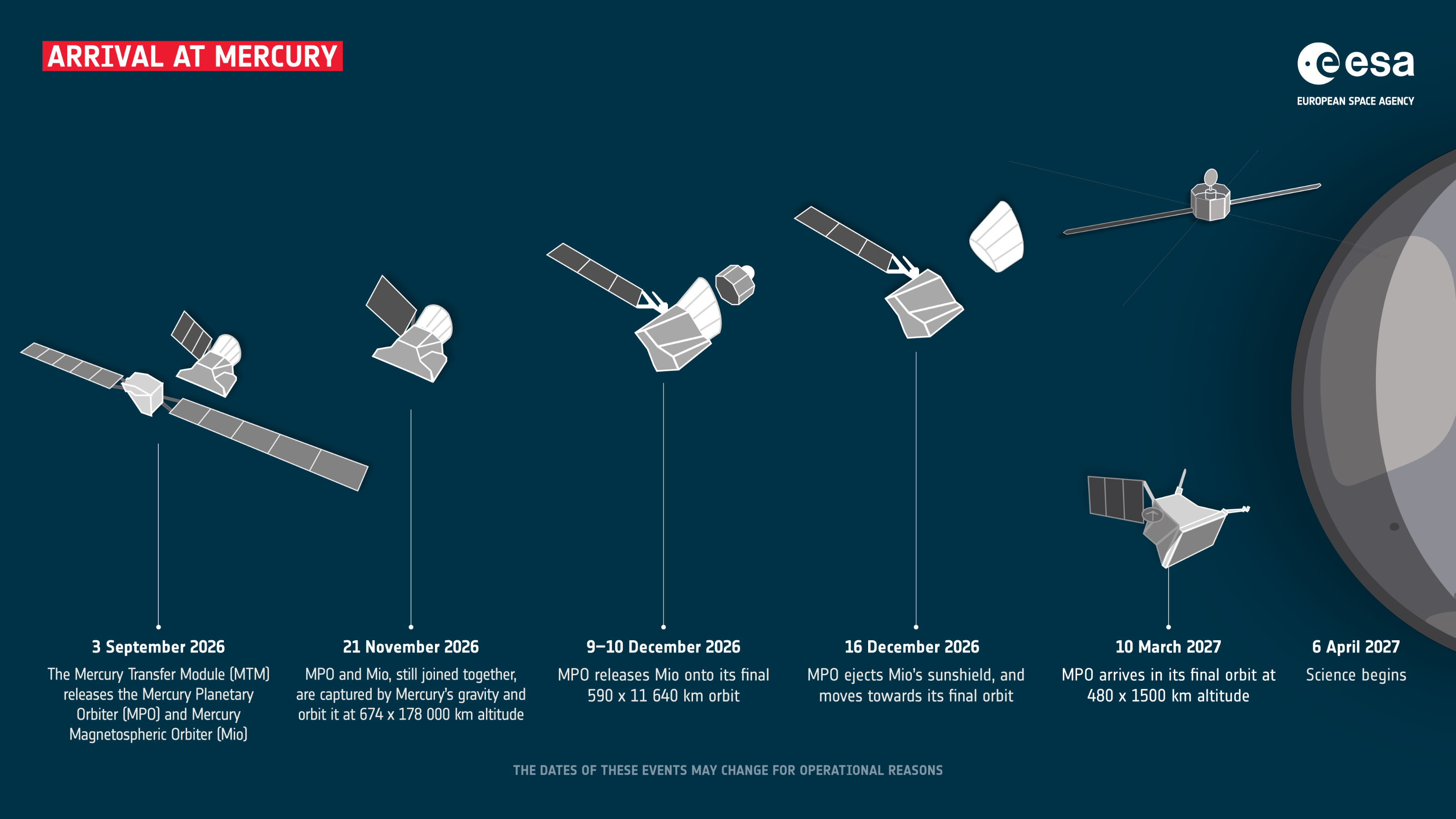
The mission continues its gradual approach to Mercury :
- November 21, 2026 : insertion into orbit around Mercury
- December 9, 2026 : Separation of MPO and Mio
- December 16, 2026 : Jettisoning of the heat shield protecting Mio
- March 10, 2027 : MPO reaches its final scientific orbit
- April 6, 2027 : Start of scientific operations