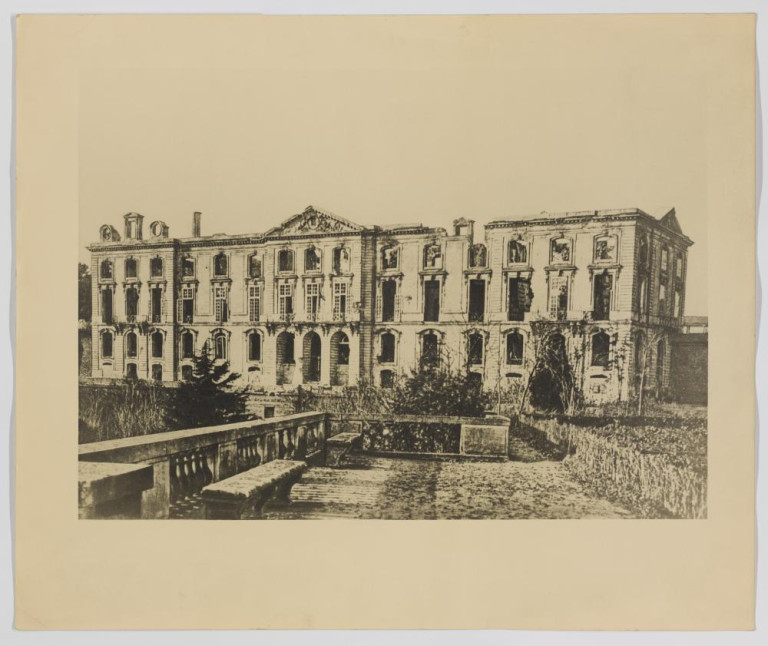
Around 1875 - 1876, the Meudon site did not yet resemble a research centre. On the terrace, at the end of the axis designed by Le Nôtre, stood the ruins of Meudon Castle, a former princely and later royal residence, ravaged by fire a few years earlier at the end of the Franco-Prussian War of 1870 - 1871.
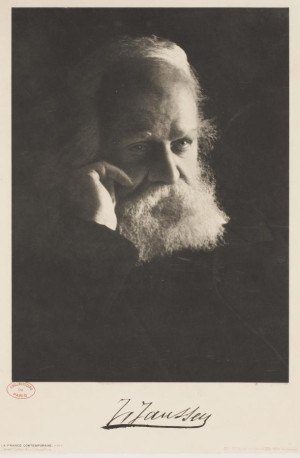
It was here that the astronomer Jules Janssen, fascinated by the Sun and by the new methods of ‘physical astronomy’, conceived a new kind of observatory.
The Birth of Astrophysics
At that time, astronomy was undergoing a major transformation. Scientists were beginning to analyse starlight using spectroscopes and to employ photography to record details invisible to the naked eye. They were no longer content merely to measure the positions of stars : they sought to understand the very nature of celestial objects through a physical approach. Astrophysics was born !
Janssen therefore dreamed of a place entirely dedicated to this approach : a physical astronomy observatory situated on the heights of Meudon, complete with domes, laboratories and instrument workshops.
The years 1875 - 1876 were a time of projects, plans and negotiations with the State to secure funding for the conversion of the château into a scientific institution.
The Meudon Observatory of Physical Astronomy was established by a decree of 6 September 1875, and in 1876, Janssen secured the observatory’s installation at the Château de Meudon.
The ruins gradually became a scientific site focused on the Sun and the stars. The large dome and its telescope were gradually installed on the remains of the château. One hundred and fifty years later, we are still working in this landscape shaped by the convergence of a former royal estate and an ambitious scientific project. The Observatory has become the nerve centre of French astrophysical research, where virtually all scientific fields are studied.
The 150th anniversary of the founding of the Meudon Observatory also marks the birth of institutional astrophysics in France ! And, by a happy coincidence, in 2026 we will also be celebrating a century since Meudon became part of the Paris Observatory, which was founded in 1667...
In 1609, Galileo pointed a telescope at the sky for the first time.
He saw mountains on the Moon, discovered the moons orbiting Jupiter, and observed a multitude of stars invisible to the naked eye. This marked a first breakthrough : the sky became an object to be observed through an instrument.
Two and a half centuries later, around 1875, a second breakthrough was on the horizon. This time, it was not merely the image of the sky that changed, but our understanding of the phenomena through the study of their physics.
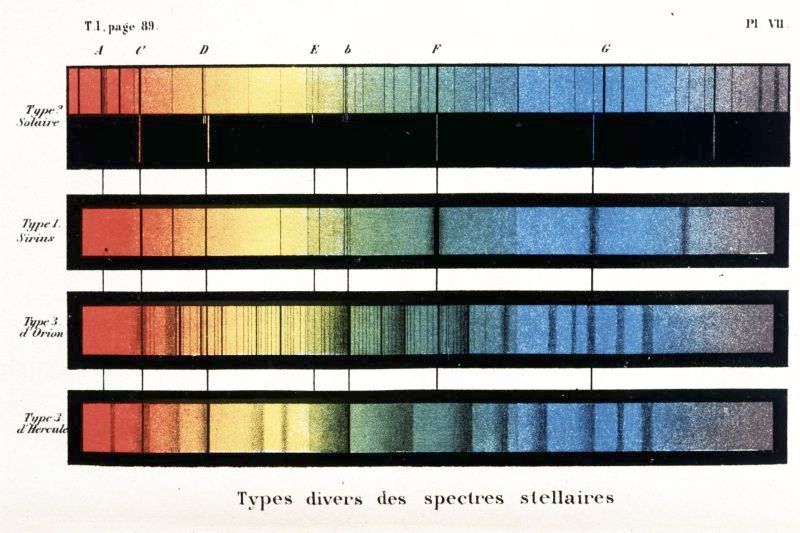
- We learn to break down the light from celestial bodies like a coded rainbow.
In the early 19th century, Fraunhofer mapped the absorption lines of the solar spectrum ; in the 1860s, Kirchhoff and Bunsen showed that each chemical element has its own unique ‘barcode’ of lines.
▶️ For the general public : this means that by looking at the light from a star, we can tell what it is made of.
▶️ For researchers : these are Kirchhoff’s laws of emission and absorption, which form the basis of spectral analysis and pave the way for the physics of radiation.
- We understand that light is an electromagnetic wave.
In the 1860s, Maxwell unified the electric and magnetic fields into a single set of equations and showed that they predict waves propagating at the speed of light in a vacuum.
▶️ For the general public : the entire spectrum (visible, infrared, ultraviolet, etc.) becomes a sort of giant stethoscope for listening to the Universe.
▶️ For researchers : this is the theoretical framework that will give meaning to spectral and polarimetric observations.
- By the end of the 19th century, thermodynamics completed the picture : it was understood that a hot body does not emit radiation randomly, and that the position of the spectrum’s peak depends on temperature (Stefan–Boltzmann law, followed by Wien’s displacement law).
▶️ For the general public : this is what allows us to say that a blue star is hotter than a red star, simply based on its colour.
▶️ For researchers : the thermodynamics of radiation provides the framework that directly links spectrum, effective temperature and flux.
- We even discover elements in stars before finding them on Earth.
In 1868, whilst studying solar prominences, Jules Janssen and Norman Lockyer identified an unknown spectral line in the Sun’s spectrum : they attributed it to a new element, helium, discovered in the star before being isolated on Earth.
▶️ For everyone : physics makes it possible to study chemistry from a distance, millions of kilometres away.
In the space of a few decades, astronomy thus evolved from a science that asked, “Where are the stars ?” to one that asked, “What are they made of, what energy do they emit, and which laws of physics apply to them ?”.
The Meudon Observatory, conceived by Janssen as an observatory for “physical astronomy”, came into being at precisely this pivotal moment : heir to Galileo and his telescope, but armed with Kirchhoff’s laws and Maxwell’s equations. It was this convergence of new instruments, new laws of physics and new questions about the heavens that marked, 150 years ago, the birth of astrophysics.