
This extensive and complex upgrade of the Very Large Telescope Interferometer (VLTI) gives the instrument increased observational power and much greater coverage of the sky than before.
Consisting of four 8.2-metre main telescopes and four 1.8-metre auxiliary telescopes, the VLT is now the world’s most advanced ground-based optical observatory.
The VLTI (Very Large Telescope Interferometer) is a mode of operation of the VLT that combines the light from several telescopes using interferometry. This method allows the VLT to observe the sky with a level of detail equivalent to that of a single giant telescope, whose diameter would correspond to the greatest distance between the telescopes.
However, despite the performance of interferometry and the fact that the VLT is located under one of the clearest skies on the planet — in the Atacama Desert in northern Chile — the Earth’s atmosphere is not a stable environment. It is made up of turbulent layers of air that distort the light from celestial objects, causing the famous twinkling of stars visible to the naked eye.
To correct for these disturbances, astronomers have developed the technique of adaptive optics, which involves analysing atmospheric turbulence in real time using a bright reference star. A deformable mirror located in each telescope is adjusted several thousand times per second, compensating for the disturbances suffered by the light and producing images as sharp as if they had been taken in space.
This technique has long been limited by the need for a reference star close to the observed target. So what can be done when there are no bright stars nearby ? The solution is ingenious : create one !
Powerful laser beams are emitted from the telescopes to excite sodium atoms in the upper atmosphere, creating an artificial star at an altitude of about 90 km. This star then serves as a reference point for correcting turbulence anywhere in the sky, opening up the entire southern sky to VLT observations and making the VLTI the most powerful optical interferometer in the world.
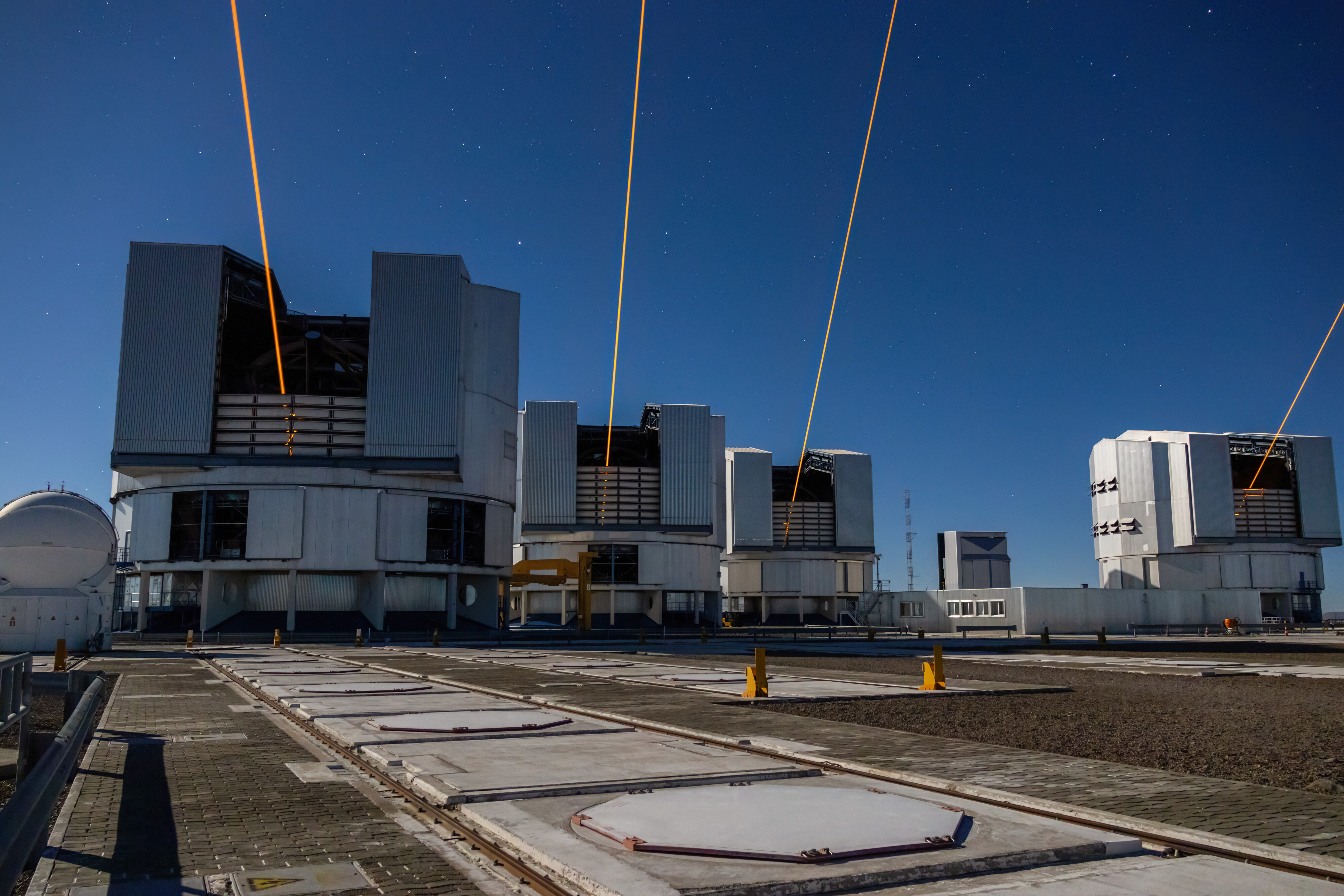
It is thanks to this breakthrough that the GRAVITY interferometric instrument, developed in part by teams from the Paris Observatory - PSL at LIRA, has been able to accomplish remarkable feats since 2016 : imaging exoplanets, observing nearby and distant stars, and studying in detail faint objects orbiting the supermassive black hole at the centre of the Milky Way.
And that makes four !
Until recently, only one of the VLT telescopes was equipped with lasers of this type. Adaptive optics based on an artificial star was therefore only possible with this telescope, preventing the combined power of the four giants from being fully exploited.
The installation of a laser on each of the three other telescopes represents a major achievement of this project, completed in record time (only five years !), taking the GRAVITY instrument to a new level of performance with GRAVITY+.
Read the rest of the article on the LIRA website.