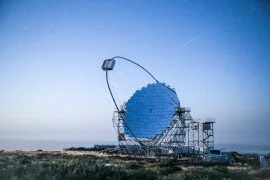
– Four Large-Sized Telescopes (LSTs) belonging to the international CTAO observatory have just been inaugurated on the island of La Palma, in the Canary Islands. They mark a new milestone in the exploration of the most energetic phenomena in the Universe.
– France is making a major contribution to the LSTs—notably through the CNRS—drawing on the expertise of several French laboratories.
– Once completed, the CTAO will be the world’s most sensitive observatory for very-high-energy gamma-ray astronomy. It will be used to study extreme astrophysical phenomena—such as supernovae and supermassive black holes—and to address fundamental physics questions, including the origin of dark matter.
A new look at the Universe’s extreme phenomena
In the Universe, supermassive black holes at the hearts of active galaxies, supernova remnants, and short-duration gamma-ray bursts are the sources of gamma rays with the most extreme energies.
The telescopes of the CTAO—specifically its four large-sized telescopes—employ the "atmospheric Cherenkov" imaging technique, which detects these gamma rays by capturing the faint, bluish flashes they produce in the atmosphere. By analyzing this light, scientists can determine the energy and direction of the gamma rays, create maps of the sky, and ultimately trace them back to the astrophysical phenomena responsible for their emission.
CTAO will be based at two complementary sites : La Palma, in the Northern Hemisphere—primarily for studying extragalactic sources—and Chile, in the Southern Hemisphere (where the second site is currently under construction), which will focus on observing the central regions of our Galaxy.
The four large-sized telescopes inaugurated at La Palma represent an initial phase in the deployment of this international observatory, the most sensitive ever built for gamma-ray astronomy. Deployment will continue at both the La Palma and Chilean sites with medium-sized telescopes ; for these, the CNRS and the CEA are coordinating the integration and testing of the "NectarCAM" cameras. Additionally, the CNRS is supplying the mechanical structures for several small-sized telescopes in Chile, while the CEA is providing 700 mirrors.
A major contribution from French research
France is one of the primary contributors to CTAO, with participation driven notably by the CNRS and the CEA.
Several laboratories from the CNRS and its partners have been involved in the design, construction, and commissioning of the four LSTs (Large-Sized Telescopes).
- The Annecy Laboratory of Particle Physics (CNRS/Université Savoie Mont-Blanc) designed, among other things, the carbon-fiber arches that support the multi-ton cameras positioned at the focal point of the 23-meter-diameter mirrors. It also developed the telescope drive system, which enables the telescopes to point toward astrophysical objects under observation and to reorient themselves in less than 30 seconds should an alert regarding a cosmic explosion be received. Furthermore, the laboratory contributed to real-time data analysis, which allows for alerts to be sent to the wider scientific community, facilitating follow-up observations.
- The Centre for Particle Physics of Marseille (CNRS/Aix-Marseille Université) designed the event-assembly software—which reconstructs each event for every telescope in real time using data from all the camera’s modules—as well as the offline camera calibration procedure, which converts raw signals into reliable physical quantities essential to the quality of scientific results.
- The Irène Joliot-Curie Laboratory for Physics of the Two Infinities (CNRS/Université Paris-Saclay) developed software to monitor its equipment and ensure it functions correctly.
The data processing and analysis tools are prototypes developed at the CEA and the CNRS. At the CEA, teams from the Institute of Research into the Fundamental Laws of the Universe (CEA) are coordinating the development of the CTAO data-processing pipeline, which will enable the reconstruction of gamma-ray characteristics based on signals recorded by the telescope cameras. French laboratories—such as the Astroparticle and Cosmology laboratory (CNRS/Université Paris Cité), with its *gamma-py* tool—are also heavily involved in developing the software used for the scientific exploitation of these telescopes, as well as for modeling the emission from the observed gamma-ray sources.
The CTAO is part of a long-term international scientific endeavor. The first four large-sized telescopes inaugurated on La Palma represent only the beginning of the deployment of this international observatory—the most sensitive ever built for gamma-ray astronomy. As the arrays are completed at both sites, they will enable the observation of the entire sky with unprecedented sensitivity, allowing for the exploration of phenomena that remain largely unknown. In particular, it will facilitate the search for potential signatures of dark matter, one of the great enigmas of contemporary physics.
CTAO benefits from a significant contribution from French laboratories.
Au CNRS :
- Laboratoire d’Annecy de physique des particules (CNRS/Université Savoie Mont-Blanc)
- Centre de physique des particules de Marseille (CNRS/Aix Marseille Université)
- Laboratoire de physique des 2 infinis Irène Joliot Curie (CNRS/Université Paris-Saclay)
- Astroparticule et cosmologie (CNRS/Université Paris Cité)
- Institut de planétologie et d’astrophysique de Grenoble (CNRS/Université Grenoble Alpes)
- Institut de recherche en astrophysique et planétologie (CNRS/CNES/Université de Toulouse)
- Laboratoire Leprince Ringuet (CNRS/École Polytechnique)
- Laboratoire de physique des 2 infinis Bordeaux (CNRS/université de Bordeaux)
- Laboratoire de physique nucléaire et des hautes énergies (CNRS/Sorbonne Université)
- Laboratoire d’étude de l’univers et des phénomènes extrêmes (CNRS/Observatoire de Paris PSL/Sorbonne Université)
- Laboratoire Lagrange (Observatoire de la Côte d’Azur/CNRS/Université Côte d’Azur).
Au CEA :
- Institut de recherche sur les lois fondamentales de l’Univers (CEA)