The β Pictoris star system, which is 20 million years old and located just 63 light-years away, is unique for the study of young planetary systems. Two gas giants were already known to exist there (b, discovered in 2008, and c, in 2019), both discovered by a French team, as well as a massive dust disk and exocomets—the first of their kind to be discovered around a star—again by a French team.
A third planet has now officially been added to the family : β Pictoris d.
A High-Precision Technological Feat
Photographing an exoplanet is a major challenge : the light from the host star is so blinding that it obscures its much less luminous companions. The team, however, rose to the challenge thanks to ERIS, a state-of-the-art instrument installed on ESO’s VLT.
The observations reveal that β Pictoris d is about 100 times less luminous than its larger sibling, β Pictoris b. With an estimated mass of only 2.4 times that of Jupiter (compared to about ten times for b and c), it ranks among the least massive worlds ever detected by direct imaging from the ground.
Analysis of its light also indicates a moderate effective temperature of 600 K (about 330 °C) and signs of methane absorption in its atmosphere, suggesting a composition enriched in metals.
Ten Years of Archives Revealed
Once the planet was detected by the ERIS instrument in the infrared, astronomers delved back into the past. By meticulously reanalyzing archival data—the oldest of which dates back 11 years (from the VLT’s SPHERE instrument and NIRCam aboard the JWST)—they realized that the planet was already present in the data, though previously invisible.
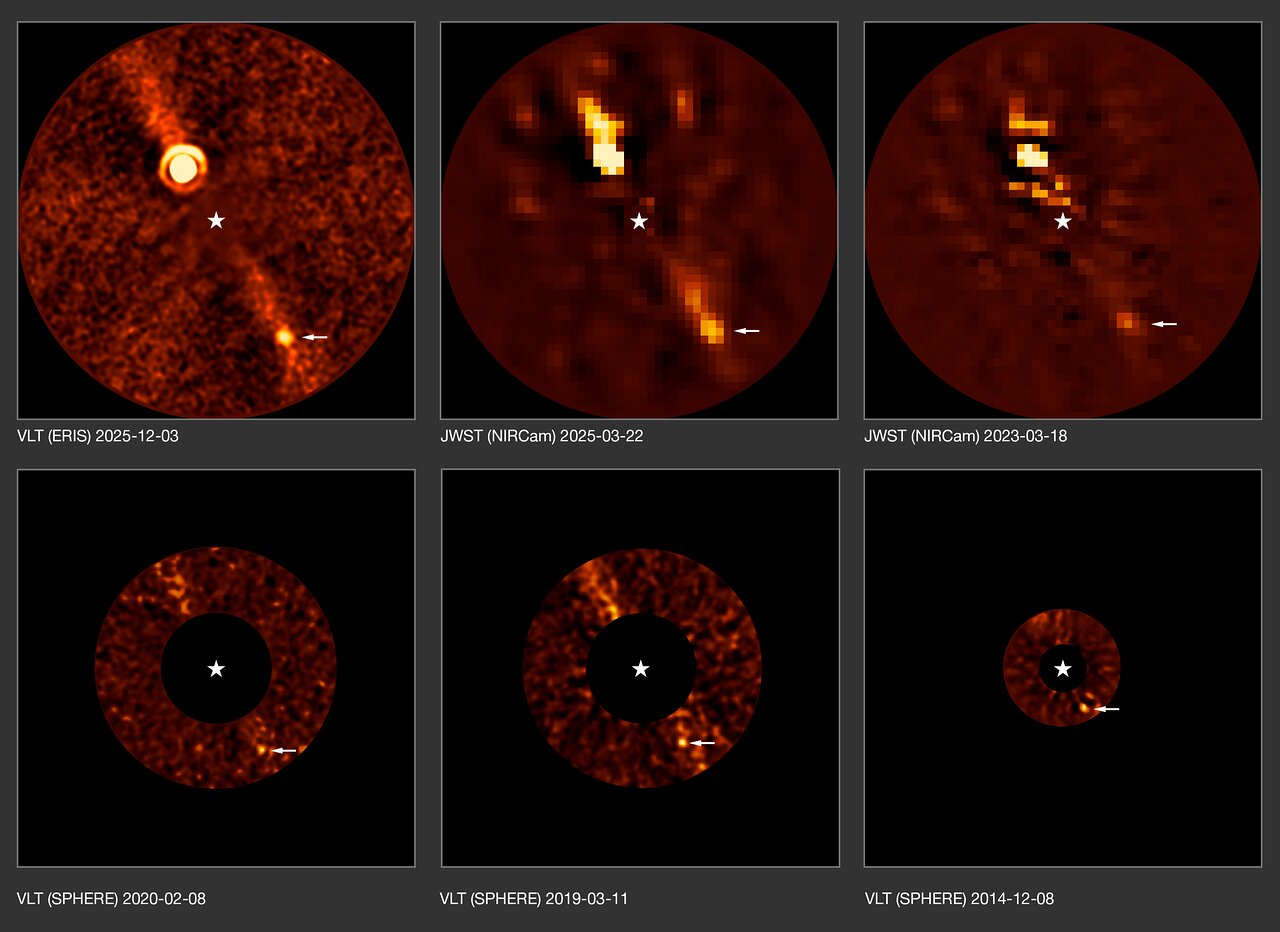
This exceptional long-term tracking made it possible to precisely map its orbit. Located about 26 astronomical units from its star (slightly less than the distance between the Sun and Neptune), β Pictoris d orbits in a plane shared with the system’s other two planets. Notably, its orbit lies close to the inner edge of the system’s protoplanetary disk, confirming its key role in the gravitational “sculpting” of this structure.
β Pictoris is now the second system, along with HR 8799, in which more than two planets have been directly observed.
This major discovery of β Pictoris d demonstrates the unprecedented sensitivity offered by current imaging techniques. Above all, it foreshadows the spectacular performance of ESO’s future Extremely Large Telescope (ELT), which will make it possible to detect even smaller and more elusive rocky worlds.
Scientific reference
‘Direct Imaging Discovery of Giant Exoplanet β Pictoris d : A Decade-Long Game of Hide-and-Seek’, by Ben Sutlieff et al., The Astrophysical Journal Letters.
Related articles
- ESO press release published on 15 July 2026 : Faintest planet ever imaged from Earth found after more than 10 years of hide-and-seek
- A second planet in the Beta Pictoris system (archive 2019)